

By Amy O’Hair
The past development of Sunnyside has been a focus of my research for posts on this site—how housing was built in the early years, how it grew, what changed over time. This week marks an important change in zoning for San Francisco, with potential future implications for this district. And we have an historical precedent here: after upzoning on Monterey Boulevard in the 1950s, a large number of new apartment buildings were constructed in the three decades that followed. Of course, zoning changes don’t make new buildings full of housing and shops appear in short order—but it does set a new direction.
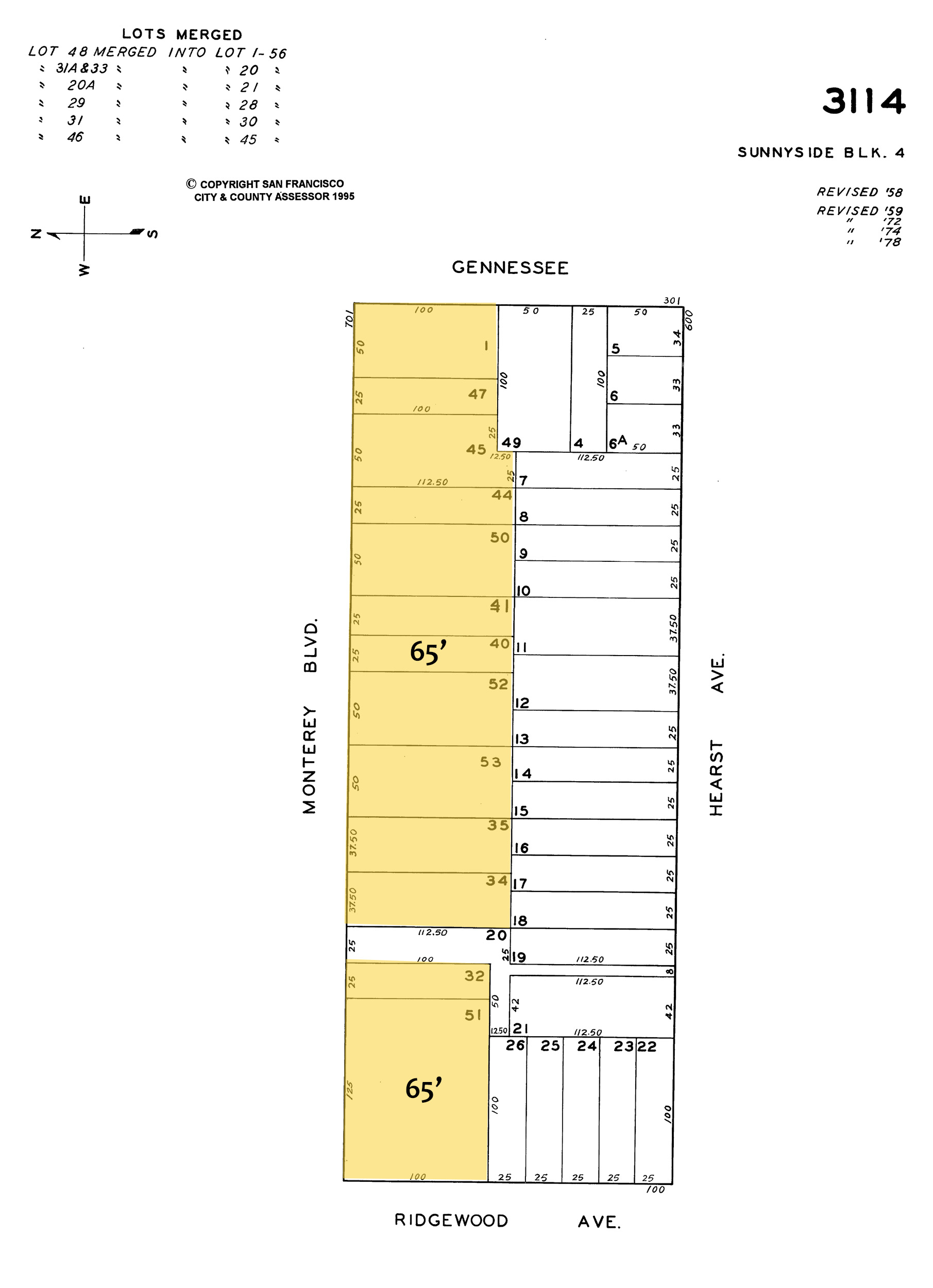
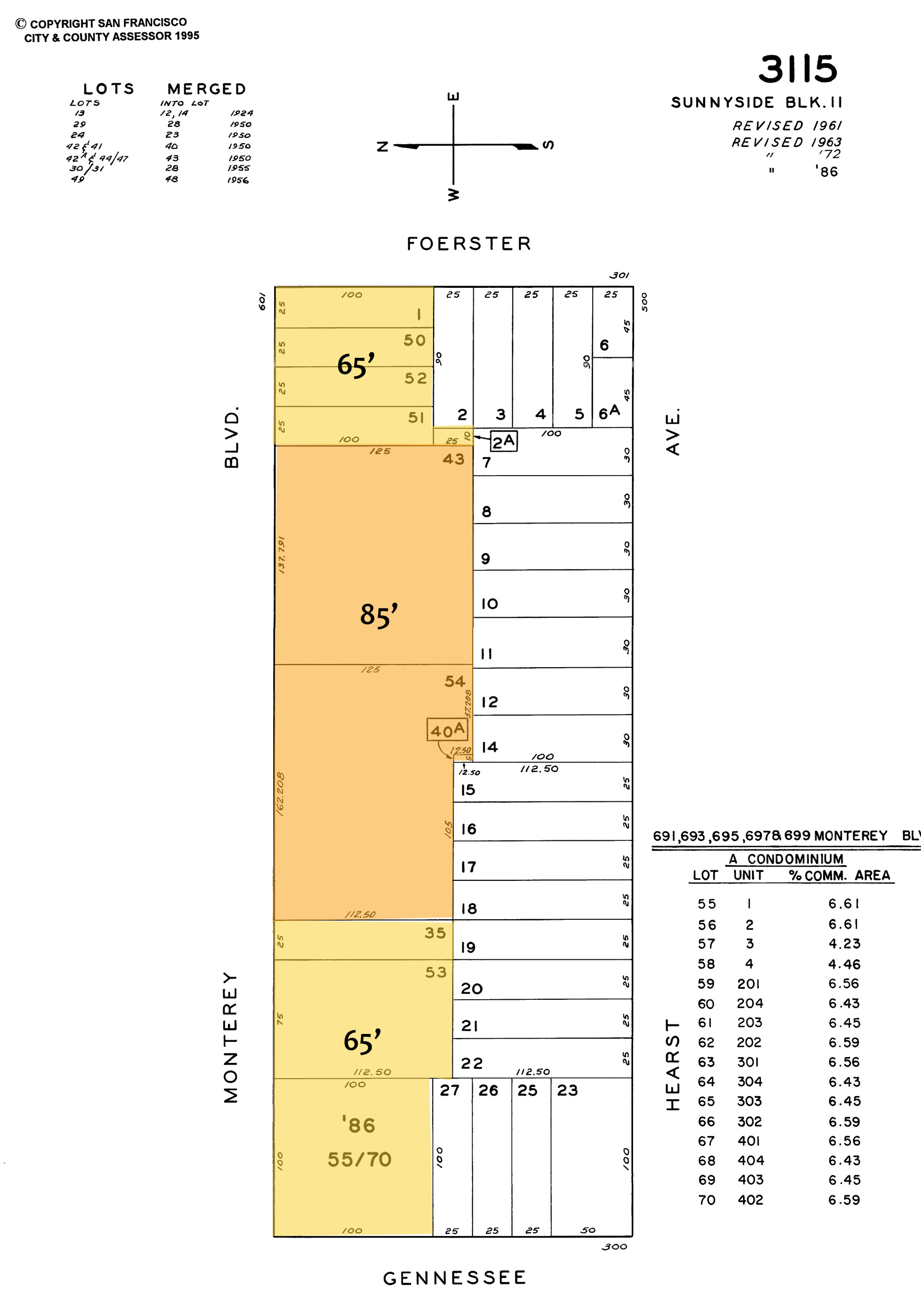
Compared to more urban areas in the city, the changes for Monterey Boulevard in the new plan are pretty modest. They most dramatically affect the two blocks from Foerster to Ridgewood, and largely only on the south side of the street. The height limit of some 40 feet is increased to 65 (five-to-six stories max) over most of the changed area, with 85 feet (seven-to-eight stories max) designated for the large lot that contains the Safeway and its parking lots—a fact that ties into emerging news stories, as I’ll get to below. The height-limit changes in Sunnyside match those throughout District 7. View the whole map here.

On the north side, three corner spots are included: the Kwik and Convenient and its parking lot at Foerster; Shanghai Dumpling King and the building next to it at Gennessee (east side); and four lots at Gennessee (west side) that includes Won Kok on the corner, the old bar-restaurant space at 716 Monterey, and the two houses in between. I’ve got some photo illustrations below exploring the changes.
You may notice an exception for a 25-foot lot close to Ridgewood at 771 Monterey, still marked gray. This odd property also includes an eight-foot-wide driveway in the rear, connecting it to Hearst, and two little pieces of other lots in the back—all of which were combined into one lot in the 1940s by some enterprising owner wanting this weird arrangement. (Mapgeeks are welcome to check out my marked-up Assessor’s maps for the two blocks here and here.) This may be why it was exempted from the increase.
On the north side of Monterey between Foerster and Edna, the height limit was raised from 32 feet to 40 feet—a change of eight feet that brings that block in line with heights designated in the 1950s on much of the rest of the boulevard.
One change that our supervisor, Myrna Melgar, managed to secure for the plan was protection for rent-controlled buildings with three or more units from redevelopment into larger housing projects. This includes at least one multi-unit building in the upzoned lots, the 11-unit building at 725 Monterey.
High in the Sky
Although height limits along these blocks in Sunnyside have been at 32 or 40 feet since midcentury rezoning, a great many of the structures here are but 20 feet tall, sometimes less. So any new building that took advantage of the new limits could introduce some stark contrasts along the boulevard. These images are my ham-fisted renderings for the areas affected, with blocky boxes drawn in to show the new limits. [Mouse over images for captions giving locations.]


Actual buildings being designed now naturally have attractive fronts, stepped back top floors, variegated surfaces and textures, and all sorts of artistry to please the eye and integrate them into existing sites. Of course, none of that presupposes that a neighborhood will welcome the changes that come with such new buildings, not least due to displacement of commercial tenants. A recent piece in the Ingleside Light recounted the ups and downs around a development at 1601 Ocean Ave at Capitol, now planned as a six-to-seven story, 101-unit mixed-use structure.
I’ve been watching the new six-story affordable housing at 3300 Mission going up over the last several months. It has snazzy triangular bay windows, and a big space on the first floor for a retail tenant.


Parking Lots to Living Spaces
City Hall’s upzoning plans have developed at the same time that Safeway’s new ventures in housing for San Francisco have been in the news. A real estate development firm called Align has plans to redevelop several of the city’s Safeways as major housing-and-retail projects.
As the Chronicle reported:
“Now with a California political landscape that is aggressively deregulating the housing construction industry, giving developers ever-increasing incentives to build bigger and faster and denser, Safeway has embraced the pro-housing mandates requiring cities across the state to zone for more density.”
There are four named Safeway sites so far: Mission Bernal, the Marina, Ocean Beach, and the Fillmore. Closest to home, here are renderings of the plans for the Mission Bernal site at Mission and 30th Street. There are to be seven stories on San Jose Ave side and six on Mission, which is where the entrance to the store would be located. 370 units are planned here.


These plans for the Marina site, at Marina Blvd and Laguna, have been ruffling wealthy feathers in that district. It is to have 485 units. I find it good to look at—with its undulating ribbons rippling around the 25-story structure—but then I don’t own an expensive view to mess up.

The Ocean Beach site, at 48th Avenue and Cabrillo, is to have 526 units. Here are two renderings.


For the Fillmore Safeway site, Align plans for a very dense 1,800-unit structure, and no replacement Safeway, which is bad news for the Western Addition residents who have relied on it for fresh food. I hope this changes.
Et Tu, Sunnyside?
Admittedly, our Safeway is the smallest in the city, being just one quarter the size of the Ocean Beach site, one third the size of the Marina site, and less than half the size of the Mission Bernal site. With the new height limits of 85 feet, the site has potential.
If a building similar in height and types of units as the Mission Bernal plans were built here, the Monterey Safeway site would provide something like 160 new units in the neighborhood—and presumably a better and bigger Safeway for everyone, with parking below, like the new Wholefoods on Ocean. Its location on the south side of Monterey means that despite its height it would generally not cast shadows on the backyards behind it on Hearst Avenue.
Safeway Hopes, Once Before
Several years ago, Sunnyside went through one process of negotiating with Safeway about the details of their plans for a store replacement—no housing included. The store was to be larger, with a parking lot covering the top, and a realigned entrance on Monterey Blvd.


Beginning in 2008, Safeway discussed their plans for renovating the store with Sunnyside Neighborhood Association on and off for many years, before abandoning the plans in 2018. I was secretary of SNA then, and was told that the difficulties stemmed from the acquisition of Safeway in 2015 by Albertsons Companies, Inc.
Had the store been rebuilt then, it might have made any housing-inclusive redevelopment unlikely now.
A Future Beckons
I think there are many Sunnyside residents who support for future changes in height and density along Monterey. Parents my age know how our adult children can’t afford to live in the city they grew up in.
Personally, in my years writing and researching about the history of this district—with so many changes here over the years—I have found myself becoming more welcoming of changes to city. I’m excited to see what will happen.

I love the Kwik & Convenient. It’s rare to have a 24 hour corner store nearby! Everything seems to close down at 9:00. I’m not fully educated on the rezoning processes, so could you explain what this would mean for my favorite corner store? Would they be made an offer so good they can’t refuse, and have to sell it to developers? Or does the city help in some way to build housing on that property and let the business remain on the first level?
Hi! I don’t know what will or won’t happen at our local Kwikie. The owners do a great business, and they do love their parking lot, which draws people in cars to shop because they know there is parking. The owners may have to retire and want to sell the store before any change happens here.
I do know that when there are ground floor tenants, sometime redevelopers can rebuild while assuring a current tenant that they will have a space in the new building. That happened when they rebuilt the burned-out building at 3318 Mission (the Cole Hardware fire), and Playa Azul restaurant moved back into the new building after it was built.
But that parking lot wouldn’t be there, after redevelopment of the Foerster/Monterey site, for any future Kwikie in the first floor of a mixed-use building, so that might make a big difference. This stuff is up in the air.
I think the northern side of Monterey b/t Foerster and Edna, where Friend’s bar is, also up zoned slightly (prev 32 feet).
Thanks for the tip. I’ve edited to include that.
I went on several of Amy’s educational history walks. Although I have lived in San Francisco almost all my life, there is always something new to discover. I live at 330 Monterey Boulevard in one of the apartment buildings. I am going to pass this article on to my friend whose parents and grandparents lived on Chenery near Diamond. The grandparents made wine in their basement, another Glen Park story.